The Strategy Loop: A Complete Step-by-Step Framework for Scaling Your Business Sustainably

Scaling a business is not about working longer hours. It is not about reacting faster. It is not about trying random ideas until something works.

Scaling is about building a repeatable system for thinking.

Most companies fail to grow not because they lack talent, effort, or ambition — but because they lack a structured strategy cycle. They make decisions emotionally, reactively, or inconsistently.

The Strategy Loop solves this problem.

It provides a structured, repeatable framework that helps leaders continuously evaluate, refine, and execute their growth strategy.

This guide will walk you through the complete system in depth.
What Is the Strategy Loop?

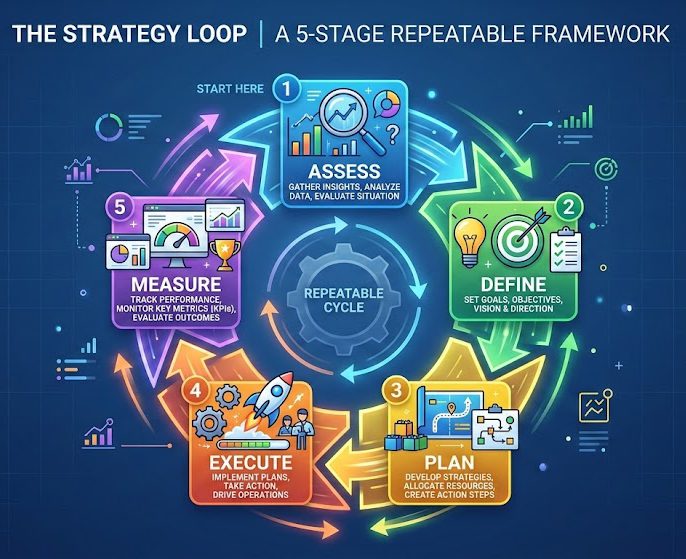
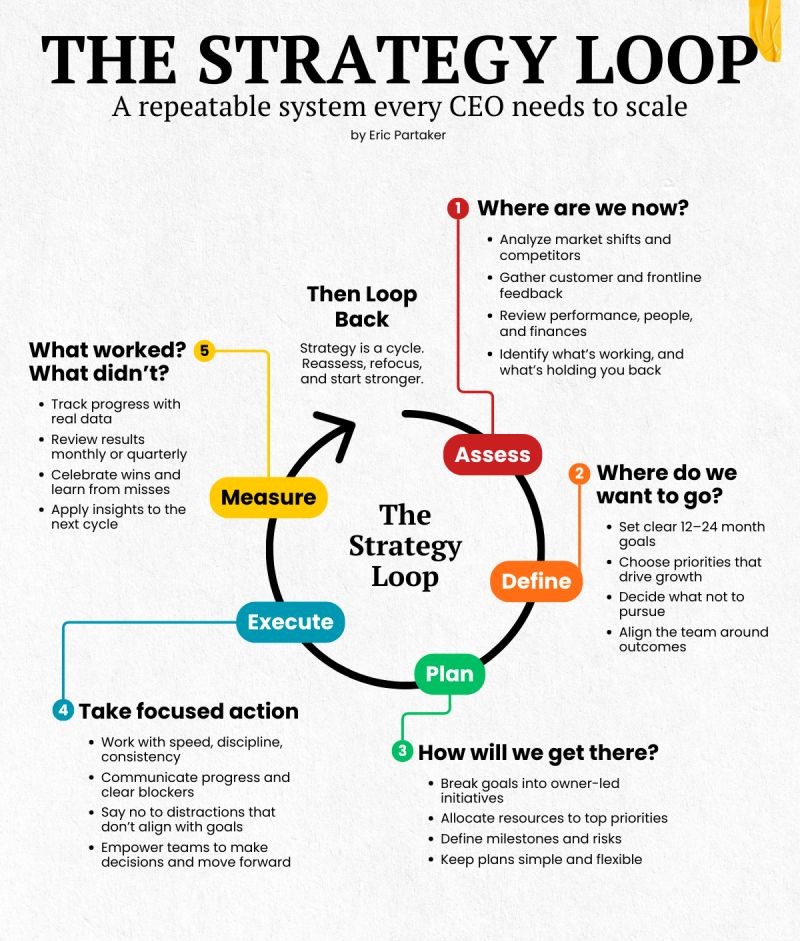
The Strategy Loop is a 5-stage repeatable framework:

  1. Assess

  2. Define

  3. Plan

  4. Execute

  5. Measure

After measuring, you go back to Assess — and repeat.
Strategy is not a one-time annual meeting. It is a continuous improvement cycle.Think of it like fitness. You don’t go to the gym once and expect permanent results. Strategy works the same way.

Stage 1: Assess — Where Are We Now?

Growth begins with clarity.Before setting goals or launching initiatives, you must understand your current reality.Most leaders skip this step because they feel pressure to “act fast.” But action without clarity creates wasted effort.

1. Market Environment

  • Is your industry growing or shrinking?

  • Are competitors shifting strategy?

  • Are customer expectations changing?

2. Customer Insight

  • Why do customers buy?

  • Why do customers leave?

  • What complaints are recurring?

3. Operational Performance

  • Are processes efficient?

  • Where are bottlenecks?

  • What tasks waste time?

4. Financial Health

  • Revenue trends

  • Profit margins

  • Cash flow stability

  • Customer acquisition cost

5. Team Capability

  • Skill gaps

  • Engagement levels

  • Leadership alignment

Stage 2: Define — Where Do We Want to Go?

After understanding reality, define direction.

Many companies struggle because they try to pursue too many objectives simultaneously.

Clarity creates alignment.

1. Strategic Horizon (12–24 Months)

  • Revenue target

  • Market position

  • Product expansion

  • Geographic growth

2. Priority Focus Areas

Select 3–5 major priorities.

Examples:

  • Improve retention

  • Expand into new market

  • Build new product line

  • Improve operational efficiency

3. What Not to Do

This is crucial.

Decide what you will ignore.
Distraction kills momentum.

Stage 3: Plan — How Will We Get There?

Strategy without execution planning is just motivation.

Planning connects vision to action.

1. Initiative Breakdown

Convert each strategic priority into initiatives.

Example:
Goal: Improve retention
Initiatives:

  • Redesign onboarding

  • Improve customer support system

  • Launch customer success check-ins

2. Ownership Assignment

Every initiative needs one accountable owner.

Shared ownership often means no ownership.

3. Resource Allocation

  • Budget

  • Time

  • Team

  • Technology

4. Milestones

Break annual goals into quarterly and monthly checkpoints.

5. Risk Identification

Identify:

  • Internal risks

  • External risks

  • Resource limitations

Stage 4: Execute — Take Focused Action

Execution is where strategy becomes reality.

Many companies create beautiful strategy slides but fail at discipline.

Execution requires:

  • Speed

  • Consistency

  • Communication

  • Accountability

1. Weekly Rhythm

Hold structured weekly execution meetings:

  • What was planned?

  • What was completed?

  • What is blocked?

2. Remove Distractions

Say no to initiatives that don’t align with strategy.

3. Empower Decision-Making

Avoid bottleneck leadership.
Allow teams to make tactical decisions.

4. Transparency

Share progress openly.
Visibility increases accountability.

Stage 5: Measure — What Worked and What Didn’t?

Measurement turns action into intelligence.

Without measurement:

  • Mistakes repeat.

  • Resources get wasted.

  • Teams lose clarity.

Financial Metrics

  • Revenue growth

  • Profit margin

  • CAC vs LTV

Operational Metrics

  • Productivity

  • Delivery time

  • Cost efficiency

Customer Metrics

  • Retention rate

  • NPS

  • Satisfaction score

Team Metrics

  • Engagement

  • Productivity

  • Skill growth

Leave a Reply

Your email address will not be published. Required fields are marked *